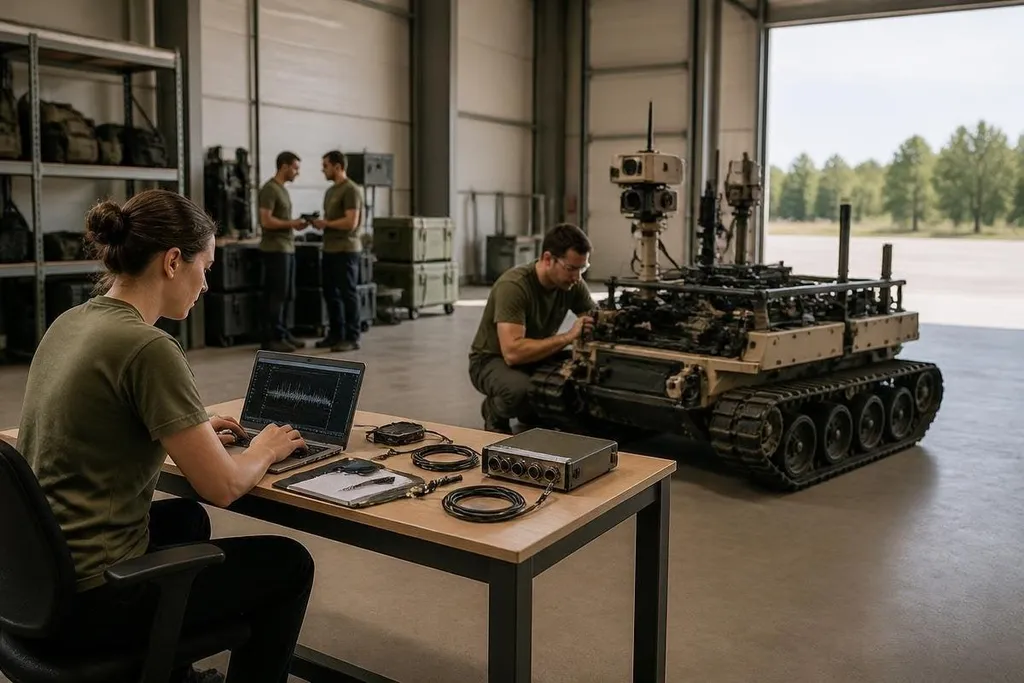
A military robot is rarely a complete product on its own. It needs sensors, control software, field repairs, operator training, secure communications, and a plan for each mission. That wider need creates business openings for companies that may never build the robot’s frame.
This article looks at those openings for a company deciding where to enter military robotics without taking on the cost of building a full platform.
- The clearest openings sit around maintenance, software, training, and data.
- Buyers will care about reliability in field conditions, not a polished demonstration.
- A small supplier needs a narrow task, a clear customer, and a route through procurement.
Where the work sits
Robot makers attract attention because the vehicle or arm is easy to show. The harder work starts when a unit reaches a base, ship, airfield, or rough outdoor site. Someone must inspect it, replace damaged parts, manage batteries, update software, and keep records for the next operator.
That creates room for repair services, spare-part supply, fleet software, battery systems, and test equipment. A company can focus on one of those jobs rather than building an entire autonomous system.
Software offers another opening. Military robots need maps, route planning, sensor checks, remote control, task logs, and links to other systems. The software must also cope with weak connections, lost positioning data, and changes to the mission. A useful product may be a control layer that works with several robot types, though compatibility must be shown rather than promised.
Data and training are business areas too
A robot collects information while it moves. Cameras, LiDAR, thermal sensors, and other payloads can produce maps, images, fault records, or site reports. Turning that data into a format that operators can read and act on can be a separate product.
The buyer may need storage, labeling tools, review software, or a secure way to send reports to another team. Those jobs matter when an operator has limited time and a mission cannot wait for a data specialist to clean every file by hand.
Training creates another path. Operators need practice with control systems, sensor limits, battery changes, faults, and recovery steps. Simulation software can let a team repeat those tasks before using a costly robot outdoors. The seller still needs to show that the training matches the real controls and failure cases.
A military robot buyer needs more than a training promise. The controls, fault cases, battery work, and outdoor setting should match the system sold. Reports on military robots at Robot24.com can give you dated details on named machines and tests before you price the support that follows purchase.
The hard part is buying, not building
A good prototype can still fail as a business. Military buyers may ask for security reviews, supply records, testing documents, training plans, repair times, and proof that the product can work with existing equipment. A small company needs to learn which office owns the problem and how that office buys new equipment.
The sales cycle can also shape the product. A tool that needs a new network, a new battery type, or a new control station may ask the customer to change too much at once. Products that fit current workflows have a clearer path, but the company must verify that fit with the intended buyer.
Security needs care from the start. A robot can expose location data, sensor feeds, software logs, and control commands. A supplier should define who can access each kind of data, how updates are approved, and what happens when communications fail. These are product requirements, not paperwork added after the first sale.
Pick a narrow opening
A new company should start with one repeated task and one buyer. “Military robotics” is too wide to guide a product plan. “Inspect battery health for a fleet of ground robots” gives the team a task, a user, a data need, and a way to test the result.
I’d avoid building a full robot first unless the company already has a clear customer and a test site. Services and software can reveal the real problem before the team spends money on motors, frames, batteries, and certification work.
Use this checklist before choosing a product area:
- Name the task: write down the job the customer needs done and its current failure point.
- Find the buyer: identify the team that owns the work, the budget, and the approval process.
- Check the fit: list the robot models, networks, sensors, and control systems the product must use.
- Plan the proof: choose a field result the customer can check, such as fewer repair hours or faster report review.
- Price the support: include training, updates, spare parts, travel, and help after delivery.
- Set the limits: state what the product cannot do when links fail, data is missing, or hardware is damaged.
The strongest opening may be a small service wrapped around an existing robot. A company that can reduce repair time, make sensor data usable, or train operators on real failure cases has a clearer business case than one selling a broad promise about autonomous warfare.
The next decision is specific: which task can the company prove with one customer and one working system?